✭☆ Richard Feynman’s Scientific Legacy & Daring Love Story
✭ Richard Feyman‘s Life-Story :
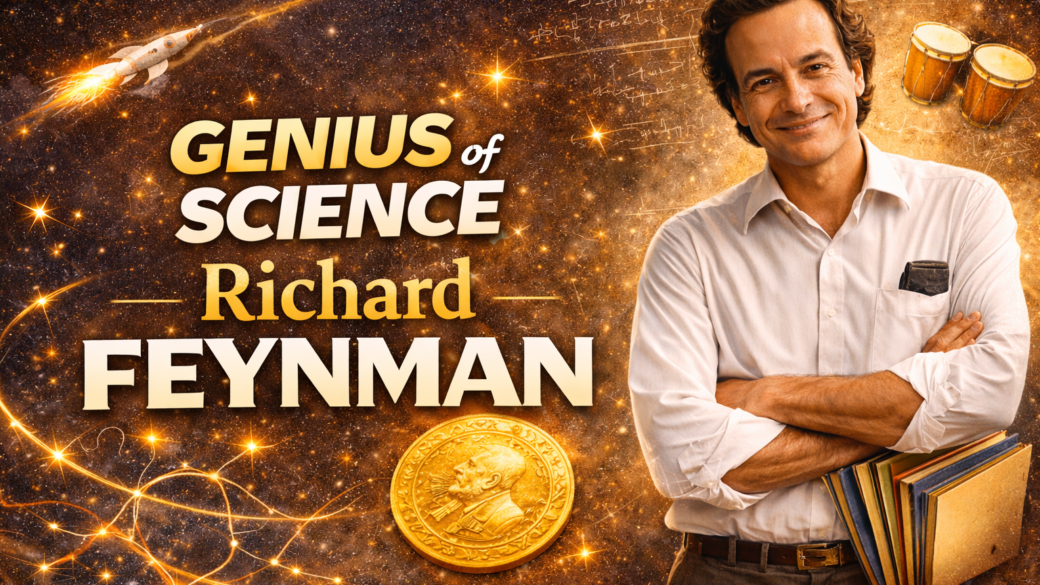
Richard Feynman was one of the most brilliant and unconventional physicists of the 20th century, known as much for his curiosity and personality as for his groundbreaking contributions to science.
☆ Birth :
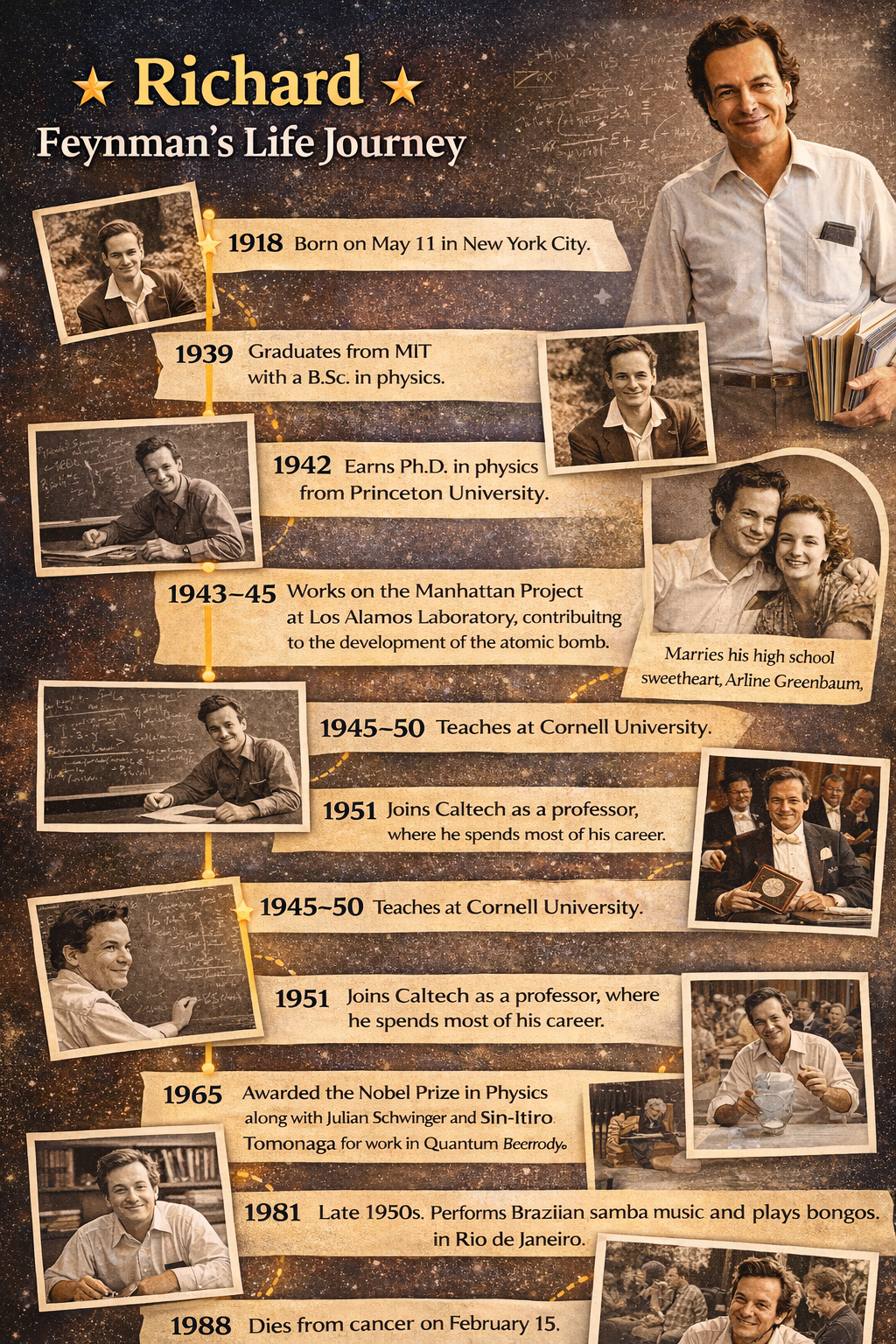
Born on May 11, 1918, in New York City, Feynman showed an early fascination with how things work. His father nurtured his curiosity by encouraging him to ask questions and think independently rather than memorize facts. This mindset shaped Feynman’s lifelong approach to science—deep understanding over rote learning.
☆ Education & Career :
Richard Feynman studied physics at Massachusetts Institute of Technology and later earned his Ph.D. from Princeton University. During World War II, he worked on the top-secret Manhattan Project at Los Alamos Laboratory, contributing to the development of the atomic bomb. Despite the gravity of the work, he was known for his playful curiosity—even cracking safes at the facility for fun.
After the war, Feynman became a professor at Cornell University and later at California Institute of Technology, where he spent most of his career. It was here that his genius truly flourished.
☆ Scientific Contribution :
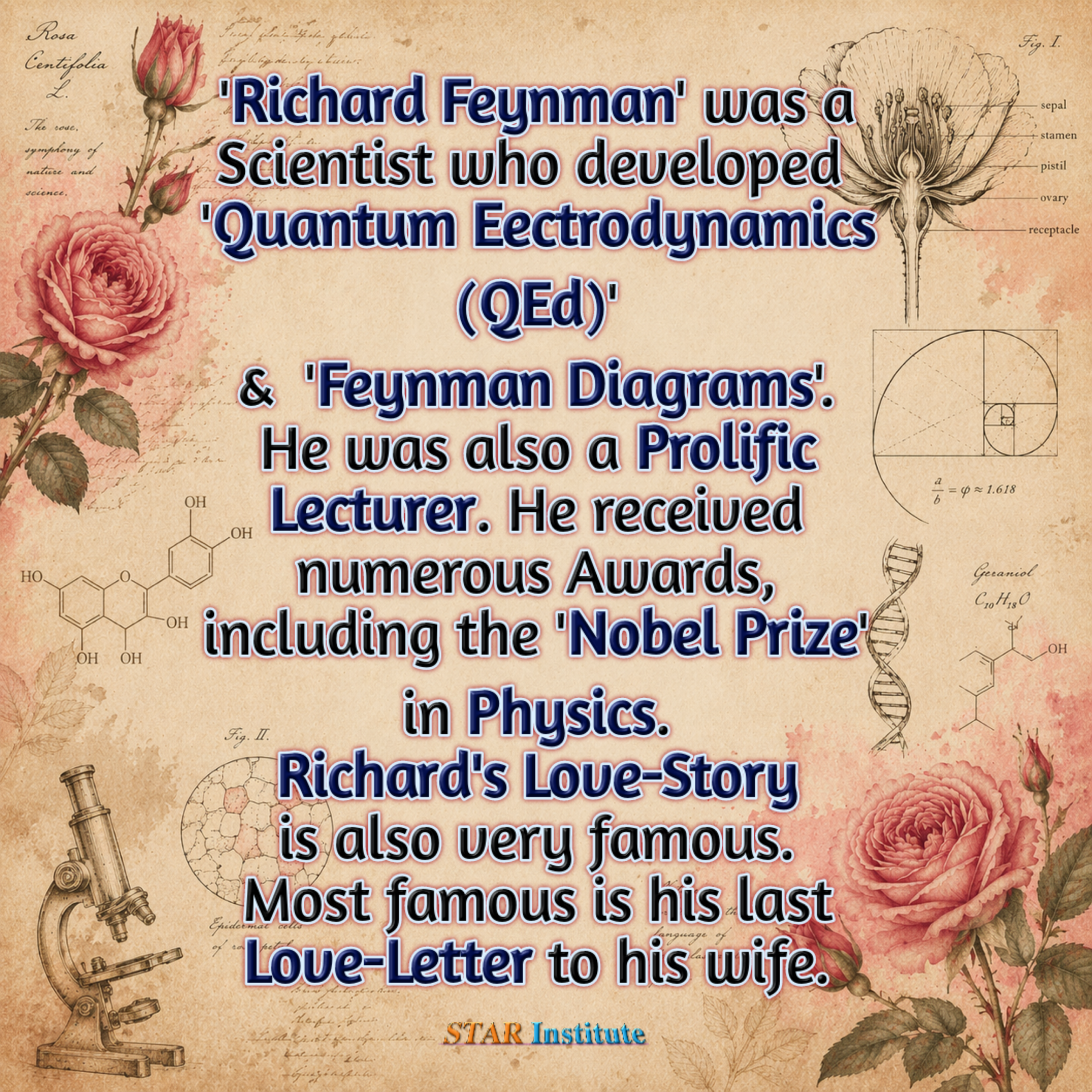
Richard Feynman’s most significant scientific contribution was to Quantum Electrodynamics (QED), the theory describing how light and matter interact. He developed a new way of understanding particle interactions using visual tools now called Feynman diagrams. These diagrams revolutionized theoretical physics by simplifying complex calculations and making them more intuitive.
For this work, he shared the Nobel Prize in Physics with Julian Schwinger and Sin-Itiro Tomonaga. His approach wasn’t just mathematically powerful—it changed how physicists think about fundamental interactions.
☆ Legendary Teacher :
Beyond research, Feynman was a legendary teacher. His lectures at Caltech were later compiled into The Feynman Lectures on Physics, which remain some of the most influential physics texts ever written. He had a rare ability to explain complex ideas in simple, engaging ways.
Feynman’s personality was equally remarkable. He played the bongo drums, loved puzzles, and had a deep appreciation for art and life. His autobiographical books, including Surely You’re Joking, Mr. Feynman!, reveal a man who embraced curiosity in every aspect of life.
☆ O-ring Seals :
In 1986, he played a crucial role in the investigation of the Space Shuttle Challenger disaster. During a televised hearing, he famously demonstrated how O-ring seals failed in cold temperatures using a simple glass of ice water—highlighting his commitment to truth and clarity.
☆ Passing Away :
Feynman passed away on February 15, 1988, but his legacy continues to shape modern science. His work laid the foundation for much of today’s particle physics, influencing technologies from electronics to quantum computing. More importantly, he inspired generations to think critically, question deeply, and find joy in discovery.
In essence, Richard Feynman was not just a physicist—he was a symbol of intellectual curiosity and the pure excitement of understanding the universe.
✭ A Journey of Love, Loss, and Genius
☆ Introduction
Richard Feynman is remembered as one of the most brilliant physicists of the 20th century. But behind his genius lies a deeply emotional love story with Arline Greenbaum—a story that reveals the human side of a scientific legend.
This article explores his year-wise love story, along with his scientific contributions, achievements, and awards.
✭ 🎵 Richard Feyman as a Musician :
Richard Feynman was not only a brilliant scientist but also a passionate lover of music, especially percussion instruments. Feynman was famous for playing the bongo drums. What started as a hobby soon became something he deeply enjoyed and practiced regularly. He became skilled enough to perform in small gatherings, parties, and even informal events during scientific conferences. His performances were lively and reflected his playful personality.
☆ 🎶 Music and Creativity
🎶 Music and Creativity
For Feynman, music was more than entertainment—it was a way to think differently. He believed that understanding rhythm and patterns in music could help sharpen the mind, much like recognizing patterns in physics. Playing music helped him relax, clear his thoughts, and approach scientific problems with fresh ideas.
☆ 🌍 His Musical Journey in Brazil
During his visit to Brazil, Feynman developed a deep interest in local music, especially samba. He didn’t just observe—he actively participated.
- He joined local music groups
- Performed in festivals
- Immersed himself in Brazilian culture
This experience showed his curiosity not just for science, but for different cultures and forms of expression.
☆ 🎨 Artistic Side
Feynman also explored other creative fields. He enjoyed drawing and sketching, and sometimes attended art classes. His artistic mindset complemented his scientific thinking, making him a well-rounded individual.
✭ 📚 Books Written by Richard Feynman
Here are some of his most popular and influential books:
- Surely You’re Joking, Mr. Feynman! – A collection of fun and fascinating stories from his life
- What Do You Care What Other People Think? – Personal stories, including his role in the Challenger investigation
- The Feynman Lectures on Physics – One of the most important physics textbooks ever written
- QED: The Strange Theory of Light and Matter – A simple explanation of Quantum Electrodynamics
- Six Easy Pieces – Basic physics concepts explained clearly
- Six Not-So-Easy Pieces – More advanced topics in physics
- The Pleasure of Finding Things Out – Reflections on science, curiosity, and life
✭ ❤️ Daring Love Story
☆ 📅 1938–1939: The Beginning
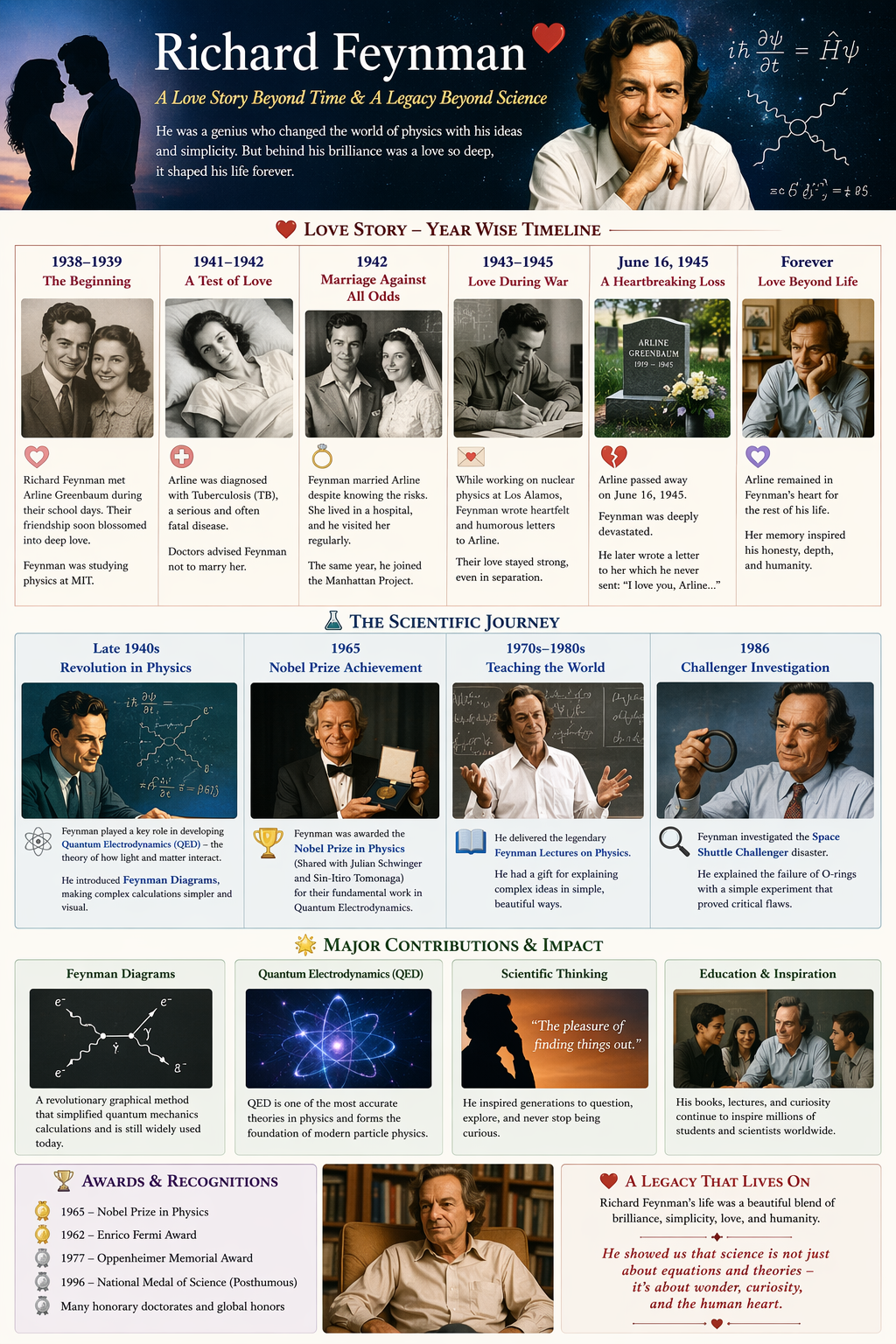
Richard Feynman met Arline Greenbaum during their school years.
- Their connection quickly grew into deep love
- Arline’s intelligence and humor made her special to Feynman
At this time, Feynman had already begun his journey in physics at MIT.
☆ 📅 1941–1942: A Test of Love
Arline was diagnosed with Tuberculosis, a serious and often fatal disease at that time.
- Doctors advised Feynman not to marry her
- Society and family also discouraged the relationship
👉 But Feynman chose love over fear.
☆ 📅 1942: Marriage Against All Odds ❤️
Feynman married Arline in 1942 despite knowing her condition.
- She lived in a hospital due to her illness
- Feynman visited her regularly, showing unwavering dedication
👉 The same year, he joined the Manhattan Project, balancing love and science.
☆ 📅 1943–1945: Love During War
While working on one of history’s most secretive projects:
- Feynman contributed to nuclear physics and bomb development
- He wrote emotional and humorous letters to Arline
👉 Their love stayed strong, even in separation.
☆ 📅 June 16, 1945: A Heartbreaking Loss 💔
Arline passed away on June 16, 1945.
- Feynman was deeply affected
- He later wrote a famous letter to her, which he never sent
“I love you, Arline…”
This letter remains one of the most touching expressions of love ever written by a scientist.

✭ 🧠 Scientific Journey & Contributions
☆ 📅 Late 1940s: Revolution in Physics
Feynman played a major role in developing
Quantum Electrodynamics (QED)
- Explained how light and matter interact
- Introduced Feynman Diagrams to simplify complex equations
☆ 📅 1965: Nobel Prize Achievement 🏆
Feynman was awarded the
Nobel Prize in Physics
- Shared with Julian Schwinger and Sin-Itiro Tomonaga
- Recognized for groundbreaking work in QED
☆ 📅 1970s–1980s: Teaching the World
- Delivered the famous “Feynman Lectures on Physics“
- Simplified complex topics for students
- Became one of the most loved science educators
☆ 📅 1986: Challenger Disaster Investigation
Feynman helped investigate the
Space Shuttle Challenger disaster
- Demonstrated the failure of O-rings using a simple experiment
- Showed how practical thinking can solve complex problems
✭ 🎁 Major Contributions to Science
☆ 🔹 Feynman Diagrams
- Visual tools that made particle physics easier to understand
☆ 🔹 Quantum Electrodynamics (QEd)
- One of the most accurate and successful theories in physics
☆ 🔹 Scientific Thinking
- Encouraged curiosity and questioning
- “The pleasure of finding things out” became his philosophy
☆ 🔹 Education Impact
- Inspired millions through teaching and books
✭ 💔 Emotional Legacy of His Love Story
Arline’s death deeply shaped Feynman’s life:
- He never forgot her
- His emotional depth reflected in his writings
- His love story showed that even great scientists feel deeply
✭ ✨ Conclusion
Richard Feynman was not just a Nobel Prize-winning physicist—he was a man of profound love and emotion.
His story teaches us:
- Love can exist even in the face of tragedy.
- Science and emotions are not separate—they enrich each other.
👉 His life remains a perfect blend of brilliance and humanity.